
By Faheem Unnisa Mahevish
The most widely discussed topic in the world today is the importance of teachers and artificial intelligence in education. International education conferences are debating this issue, and university research papers are based on it. Currently, there are two main schools of thought. One believes that artificial intelligence is an easy way to deliver knowledge to every child. The other school includes educational experts and human rights organisations. UNESCO and international human rights organisations believe that education is not merely the transfer of data or information, but that ‘the true purpose of education is character building, social awareness, and the cultivation of values’.
If we want to present a complete and comprehensive concept of development, it is based on ‘a beautiful image of society, education, independence, and intellectual freedom, alongside high levels of technological progress’. But can development, in a single sentence, be fully realised in learning and its practical application in human minds? Who can be opposed to development? Development becomes objectionable when human values do not flourish in society, when development exists only in name.
The source of all development and its centre is ‘knowledge’. Before knowing the facts, one should be aware of both the advantages and the disadvantages of modern educational tools linked to teaching methods. If the disadvantages are examined first, one can clearly gauge how much the rapid pace of time has set aside many benefits in this field in favour of development. Education is a continuous process that never stops.
Artificial intelligence has revolutionised every field. It is becoming necessary in every area and every sphere. Its speed and efficiency are such that results are obtained within a few seconds. Education is its first field. Now it is necessary to examine its drawbacks within education, because the primary aim of education is intellectual and moral development. Does it contribute to developing human insight? Will learning succeed through it? Understanding this is necessary not only for teachers but for every educated person, because it is a double-edged sword. Before it becomes widespread, its effects should be evaluated and awareness of its use should be awakened.
Can teachers and AI be equal? Can AI replace teachers? If not, why not? How important is human interaction as the natural source of learning? And can machines teach humans human qualities? How are machines responsible for the decline of moral values? Teachers are the builders of society. If builders use machines only for administrative affairs, the administrative goals of education are achieved. But if AI becomes the centre of knowledge and the learner…?
Traditional education depends on human interaction. Teachers not only provide educational instruction but also provide emotional security and guidance. No matter how effective an AI system is, it cannot provide students with the spirit of imitation. It cannot replace teachers in understanding and emotional support. It cannot replicate the personal connection of teachers. The development of students is naturally dependent on emotional, intellectual, and imitative connections. There is also a fear that the absence of human connections may fail to give students a sense of right and wrong.
The emotional and social development of students is greatly affected. Examining the negative effects of AI on students’ education and teaching is the most important requirement of today’s era, because learning from AI may create challenges for students’ emotional and social development, the consequences of which society may have to bear in the future. Although AI, across the world, can illuminate the possibilities of a more equitable and effective educational environment, its use in education promotes moral concerns regarding accountability, transparency, and student autonomy. Other ethical concerns, such as data privacy, possible bias in algorithms, and academic integrity, are also among the issues, so a cautious approach needs to be promoted.
Human connection is an effective means of learning. The interaction between teacher and student becomes unimportant when an AI tool becomes a substitute for the teacher. This deprives students of a real connection necessary for their intellectual and emotional development. Can students understand complex and tangled information emotionally? Certainly not. Does the likelihood of students’ ethics being violated increase? This debate is still ongoing. We know that ethics are implemented through feeling and observation, which requires a model of imitation, and undoubtedly, that can only be teachers, because educational institutions are not merely a means of access to information but provide the best means for the continuation and training of moral, social, and cultural civilization.
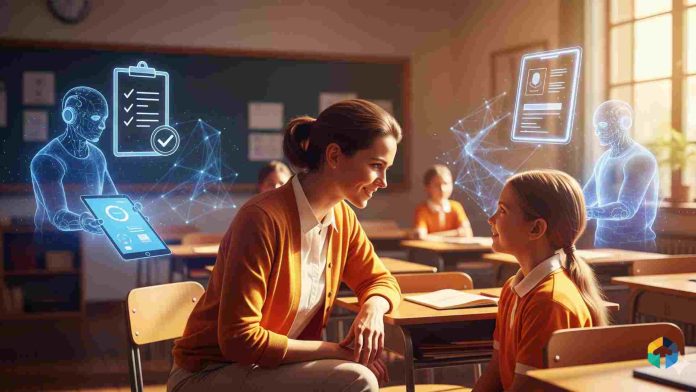
Teachers consciously and unconsciously carry out the responsibility of students’ moral and emotional training. They make students feel their presence, which gives them a natural sense of security, whether it is fear of learning or fear of making mistakes. They fulfil the duty of encouraging students, which gives them the spirit to learn. Despite all of AI’s progress and usefulness, AI can never be a substitute for teachers. Even if it analyses data or eases physical tasks, it can only transfer information, whereas education is not merely the transfer of information. It is the responsibility of teachers to shape students’ personalities, train them, and awaken human consciousness.
The spiritual and moral training of teachers and students: character building and mentorship. Teachers refine the behaviour, morals, and character of students. They try to help students become good human beings and polish their qualities of empathy, patience, and honesty. Through feelings, they set an example of becoming better people, and they awaken the spirit of imitation, which causes students to develop a sense of adopting every good quality and imitating anyone, from anywhere. Whereas AI, deprived of feelings, can provide essays and speeches on ethics, but it cannot provide practical training in moral values.
Empathy and emotional intelligence: the values of emotion and compassion. Just as teachers keep watch over the formation and deterioration of their students’ morals, behaviour, and values, AI cannot do so. Teachers are the source of developing spiritual qualities in students and are skilled at teaching them compassion, respect, patience, and honesty.
Flexible and context-based teaching: adaptability and contextual pedagogy. Teachers look into their students’ eyes and sense their fears, their laziness, and their anxieties, and they use their abilities to overcome them by adopting suitable teaching methods. They are a kind guide for students, paving the way to success with sometimes strictness and sometimes gentleness. Teachers determine teaching strategies keeping in mind the classroom environment and individual differences. Through their observation and study experiences, and sometimes by narrating events and stories, they make their teaching effective. AI, on the other hand, has no store of practical experience, observation, or study of its own, because it only has patterns and data created by humans.
Teachers foster critical and creative thinking: inspiring critical thinking. Teachers nurture critical and creative ability in students through questions, debate, and dialogue. They motivate students to develop critical and creative capacities. They compel students to think for themselves, to reflect, and to form their own viewpoints. The teacher brings out the hidden abilities of the student, whereas AI dims and even defeats students’ existing abilities, because through AI, students’ intellectual growth fades, and ready-made answers cannot develop their skills. When students face challenges given by teachers, ready-made answers reduce the value of their effort in thinking.
Discipline and accountability among students: discipline is essential to education and depends on the responsibility of teachers. Teachers make students practise discipline regularly so that they apply its meaning in their real lives and achieve better results. The presence of teachers in the classroom creates a sense of discipline and responsibility, whereas in front of a digital screen, students do not develop a sense of respect, responsibility, and accountability. In front of a living and dignified being, they answer with respect and accountability, take responsibility for their mistakes, and adopt discipline by observing its practical side.
The real purpose of education is not to pour information into the mind but to polish the soul and intellect of students, and only teachers can truly accomplish this.
Recent research shows that AI is not a replacement for teachers but rather a supportive tool for them. According to UNESCO, considering AI a replacement for teachers amounts to destroying the spirit of education. Therefore, we must reach the conclusion as soon as possible that the need to develop students’ emotional intelligence and human qualities can be fulfilled only by teachers, and these are the highest qualities. Whereas in interaction with AI, students have zero emotional response. The personality building of students is carried out at the highest level by teachers, whereas through AI it becomes extinct. Teachers are guides and trainers for students, whereas AI proves to be merely a supportive tool.
Recent research shows that AI is not a replacement for teachers but rather a supportive tool for them. The current global consensus focuses on this point: artificial intelligence can neither eliminate teachers nor become their substitute.
Now we can finally understand that in the coming era, AI cannot take the place of teachers, although teachers may replace those teachers who are unfamiliar with AI.